Investigating the Dilution Series
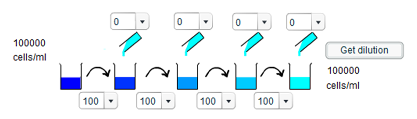
1) It is clear the highest concentration which is achievable is the
original concentration of 100000 cells/ml, which results in
transferring solution between subsequent beakers but without adding
any additional water.
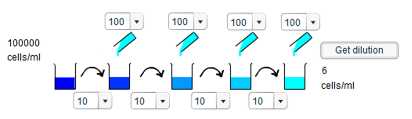
The smallest concentration results from transferring the minimum
amount of solution each time (10ml) but adding the maximum amount
of water (100ml). This gives a minimum final concentration of 6
cells/ml.
2) It should be noted that for several of the required dilutions,
there are more than one possible way to make them. However, only a
single solution is provided below:
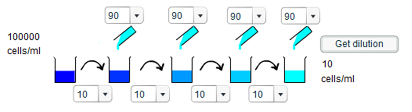
a) To achieve a concentration of 10 cells/ml requires a dilution of
10,000 times. Since we have four opportunities to dilute the
original solution, this logically requires a tenfold dilution each
time. Thus, 10ml of solution should be transferred each time, and
90ml of water added to it.
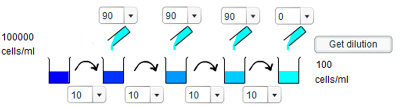
b) To give a concentration of 100 cells/ml, the same process should
be repeated as in a) except that the final addition of water should
not occur. Thus only three tenfold dilutions occur, and so the
final concentration is 100 cells/ml as opposed to 10
cells/ml.
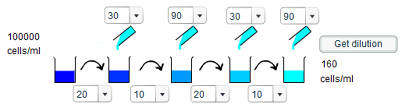
c) To give a concentration of 160 cells/ml requires a 625 times
dilution, which can be decomposed into a two 2.5x dilutions and two
10x dilutions. Thus, to give the required concentration involves
taking 20ml of solution and adding 30ml of water, and then taking
10ml of solution and adding 90ml of water, before repeating both of
these steps.
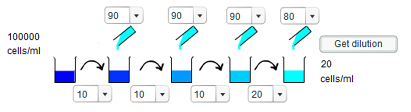
d) To achieve a 20 cells/ml concentration is similar to that of the
10 cells/ml dilution, except that the final step is different.
Rather than taking 10ml of solution and adding 90ml of water to
give a tenfold dilution, 20ml of solution is taken and 80ml of
water adding to give a fivefold dilution.
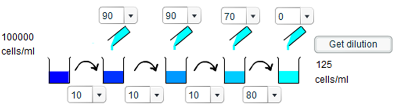
e) To give a concentration of 125 cells/ml requires a dilution of
800 times. This can be easily decomposed into two tenfold dilutions
and one eightfold dilution. Thus, the first two dilution steps
involve taking 10ml of solution and adding 90ml of water, whereas
the third step involve staking 10ml of solution and adding 70ml of
water. The final step involves no addition of water.
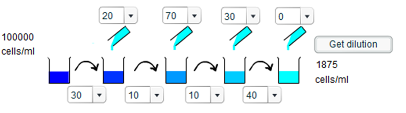
f) A concentration of 1875 cells/ml requires a dilution of
$\frac{160}{3}$. We are essentially saying that $100000 \times
\frac{3}{160} = 1875$, and so require up to four fractions which
multiply together to give $\frac{3}{160}$. Three such fractions are
$\frac{3}{5}$, $\frac{1}{8}$ and $\frac{1}{4}$. Thus, the first
dilution involves taking 30ml of solution and adding 20ml of water;
the second involves taking 10ml of solution and adding 70ml of
water; the third involves taking 10ml of solution and adding 30ml
of water; whereas the fourth requires no addition of water.
3) At each dilution stage it is possible to transfer between 10 and
100ml of solution (in 10ml intervals) and then add between 0 and
100ml (in 10ml intervals) of water. This gives a possibility of 110
different combinations, but unfortunately these are not all unique
dilutions. For example, taking 10ml of solution and adding 10ml of
water will give the same dilution as taking 20ml of solution and
adding 20ml of water. By looking carefully at all these different
dilutions (by writing them out!) it can be deduced that there are
64 different unique dilutions possible.
4) A dilution of 1/11 can be made very simple: just take 10ml of
solution and add 100ml of water. However a dilution of 1/17 is
impossible to make exactly: it cannot be created in a single
dilution since no less than 10ml of solution can be taken, and no
more than 100ml of water can be added. Also, because 17 is a prime
number, it cannot be created in two or more dilutions.
5) A dilution of 1/21 can be made by recognising that the fraction
can be written as a product of 1/3 and 1/7. Thus, using two
dilutions 1/21 can be made: firstly take 10ml of solution and add
20ml of water. Next, take 10ml of this new solution and add 60ml of
water.
A dilution of 1/95 cannot be made exactly. 1/95 can be decomposed
to 1/5 x 1/19. Although a dilution of 1/5 can be made, it is not
possible to then dilution this by a factor of 19. This is because
not only can a 1/19 dilution not be made in a single step, but also
that it cannot be made in subsequent steps because 19 is a prime
number.
6) Investigation of a few dilutions should hopefully indicate that
dilutions cannot be made for reciprocals of prime numbers greater
than 11 !