If the three inputs add up to at least 15mV, the neuron will fire. If two of the inputs are $x$mV and $y$mV, the third input needs to be at least $(15-x-y)$mV.
We find the truth table for the OR function, as expected.
| A\B | 0 | 1 |
| 0 | 0 | 1 |
| 1 | 1 | 1 |
Here's the truth table for the second network, which turns out to be the XOR function.
| A\B | 0 | 1 |
| 0 | 0 | 1 |
| 1 | 1 | 0 |
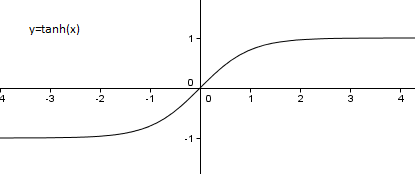
Here's a sketch of the first graph:
We can see the limit as $x\rightarrow \infty$ is $1$ and it's $-1$ as $x\rightarrow -\infty$.
Here's the second function, called the logistic function:
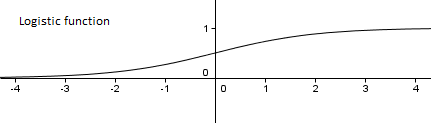
It tends to $0$ as $x\rightarrow -\infty$ and $1$ as $x\rightarrow \infty$. At $0$, the function's $\frac{1}{2}$.
These have a continous derivative, which is very useful when calculating the weights in the "learning" stage. The fact that the gradient is positive models the idea that the neuron fires more rapidly as the input increases. The asymptotic behaviour is consistent with the fact a neuron has a maximum fire rate.