| Area of maths |
Style |
Question |
Description |
| Dynamics |
See also the dynamics problems on the physNRICH pages |
 |
Model Solutions |
How do these modelling assumptions affect the solutions? |
 |
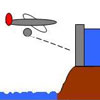
Dam Busters 1 |
At what positions and speeds can the bomb be dropped to destroy the dam? |
 |
Ramping it Up |
Look at the calculus behind the simple act of a car going over a step. |
|
Dam Busters 2 |
Can you work out which of the equations models a bouncing bomb? Will you be able to hit the target? |
 |
Making More Tracks |
Given the equation for the path followed by the back wheel of a bike, can you solve to find the equation followed by the front wheel? |
| Structural engineering |
 |
Overarch 1 |
This short question asks if you can work out the most precarious way to balance four tiles. |
|
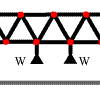
Bridge Builder |
In this short problem we investigate the tensions and compressions in a framework made from springs and ropes. |
|
More Bridge Building |
Which parts of these framework bridges are in tension and which parts are in compression? |
|
Overarch 2 |
What is the furthest a tower can theoretically arch over? |
|
Beam Me Up |
Look at the mathematics of the bending of beams. |
|
Euler's Buckling Formula |
Find the critial load at which a beam will buckle. |
| Digital circuits and logic |
|
Procedure Solver |
Can you think like a computer and work out what this flow diagram does? |
 |
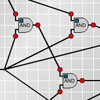
Adding Machine |
Can you set the logic gates so that this machine can decide how many bulbs have been switched on? |
|
Not Another NAND! |
Prove that you can make any type of logic gate using just NAND gates. |
|
Circular Circuitry |
What will happen when you switch on these circular circuits? |
| Decisions, logistics and control |
|
Maximum Flow |
Given the graph of a supply network and the maximum capacity for flow in each section find the maximum flow across the network. |
|
Pattern Recognition |
What is a random pattern? |
| Mechanical engineering |
|
Building up Friction |
A series of activities to build up intuition on the mathematics of friction |
|
Stonehenge |
Explain why, when moving heavy objects on rollers, the object moves twice as fast as the rollers. Try a similar experiment yourself. |
|
Stonehenge Is Going Nowhere |
See why extensions of the ideas of the log rolling in Stonehenge would lead to a lack of progress in activity! |
| Power, work and energy in engineering |
See also the Power, Work and Energy problems on the physNRICH pages |
|
|
Explore the power of aeroplanes, spaceships and horses. |
|
Go Spaceship Go |
Show that even this powerful spaceship will eventually run out of overtaking power. |
|
Turbo Turbines |
A look at power generation using wind turbines.
|
| Fluid mechanics |
See the Fluids Problems on the physNRICH pages |
| Electrical Engineering |
|
The Wheatstone Bridge |
Explore the mathematics behind the famous Wheatstone Bridge circuit. |
|
A Circuit Problem |
Find the voltages and currents in this interesting circuit configuration. |
|
Battery Modelling |
Find out how to model a battery mathematically. |
|
Differential Electricity |
As a capacitor discharges, its charge changes continuously. Find the differential equation governing this variation. |
|
Impedance Can Be Complex! |
Put your complex numbers and calculus to the test in this impedance calculation. |
| Articles |
|
AC/DC Circuits |
Find out how Ohm's law develops and find a fundamental link to complex numbers along the way. |
|
Who Is an Engineer? |
This short article gives a quick perspective of engineering after one year of a university engineering course and will be useful to help to understand what exactly goes on during an engineering degree course. |