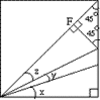
8 Methods for Three by One
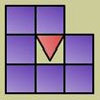
This problem in geometry has been solved in no less than EIGHT ways by a pair of students. How would you solve it? How many of their solutions can you follow? How are they the same or different? Which do you like best?
This problem in geometry has been solved in no less than EIGHT ways by a pair of students. How would you solve it? How many of their solutions can you follow? How are they the same or different? Which do you like best?

Unofficial working page and information for the Cambridge Mathematics Education Project
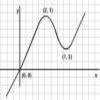
Looking at small values of functions. Motivating the existence of the Taylor expansion.

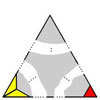
Shows that Pythagoras for Spherical Triangles reduces to Pythagoras's Theorem in the plane when the triangles are small relative to the radius of the sphere.

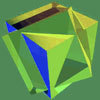
In this problem we see how many pieces we can cut a cube of cheese into using a limited number of slices. How many pieces will you be able to make?
This problem provides training in visualisation and representation of 3D shapes. You will need to imagine rotating cubes, squashing cubes and even superimposing cubes!

In this short problem, can you deduce the likely location of the odd ones out in six sets of random numbers?
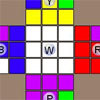
This is an interactive net of a Rubik's cube. Twists of the 3D cube become mixes of the squares on the 2D net. Have a play and see how many scrambles you can undo!
Details of the Motivate Video Conference on Proof given on 13th October 2008

A visualisation problem in which you search for vectors which sum to zero from a jumble of arrows. Will your eyes be quicker than algebra?

Takes you through the systematic way in which you can begin to solve a mixed up Cubic Net. How close will you come to a solution?
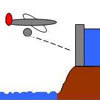
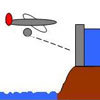
Can you work out which of the equations models a bouncing bomb? Will you be able to hit the target?
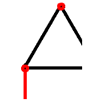
In this short problem we investigate the tensions and compressions in a framework made from springs and ropes.
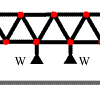
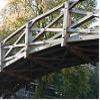
Which parts of these framework bridges are in tension and which parts are in compression?

This short question asks if you can work out the most precarious way to balance four tiles.

Help the bee to build a stack of blocks far enough to save his friend trapped in the tower.

Solve these differential equations to see how a minus sign can change the answer

Match the descriptions of physical processes to these differential equations.
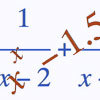
In this short problem, try to find the location of the roots of some unusual functions by finding where they change sign.

Given the equation for the path followed by the back wheel of a bike, can you solve to find the equation followed by the front wheel?
Work in groups to try to create the best approximations to these physical quantities.

A brief outline of the mathematical issues faced by chemistry students.

Can you set the logic gates so that this machine can decide how many bulbs have been switched on?
This tool allows you to create custom-specified random numbers, such as the total on three dice.

By exploring the concept of scale invariance, find the probability that a random piece of real data begins with a 1.
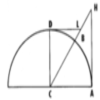
Look at the advanced way of viewing sin and cos through their power series.

How fast would you have to throw a ball upwards so that it would never land?
Try to solve this very difficult problem and then study our two suggested solutions. How would you use your knowledge to try to solve variants on the original problem?
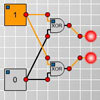
Can you set the logic gates so that the number of bulbs which are on is the same as the number of switches which are on?

Think that a coin toss is 50-50 heads or tails? Read on to appreciate the ever-changing and random nature of the world in which we live.
Weekly challenges are here for NRICH! To celebrate this event, we've collected a set of 20 essential problems for you to try.
Explore the possibilities for reaction rates versus concentrations with this non-linear differential equation
When does a pattern start to exhibit structure? Can you crack the code used by the computer?
bioNRICH is the area of the stemNRICH site devoted to the mathematics underlying the study of the biological sciences, designed to help develop the mathematics required to get the most from your study of biology at A-level and university.

Work with numbers big and small to estimate and calulate various quantities in biological contexts.
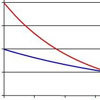
Get into the exponential distribution through an exploration of its pdf.

Can you work out how to produce the right amount of chemical in a temperature-dependent reaction?
The mathematical content of A-level and GCSE is described, along with its relevance to science students
STEM students at university often encounter mathematical difficulties. This articles highlights the 8 key problems for biologists.
Are these statistical statements sometimes, always or never true? Or it is impossible to say?
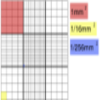
Practise your skills of proportional reasoning with this interactive haemocytometer.
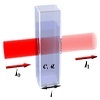
Here are several equations from real life. Can you work out which measurements are possible from each equation?

What 3D shapes occur in nature. How efficiently can you pack these shapes together?

Which dilutions can you make using 10ml pipettes and 100ml measuring cylinders?

Investigate the mathematics behind blood buffers and derive the form of a titration curve.

Need some help getting started with solving and thinking about rich tasks? Read on for some friendly advice.

This gives a standard set of questions and tips for running rich tasks in the classroom.

Can you visualise whether these nets fold up into 3D shapes? Watch the videos each time to see if you were correct.

Practice your skills of measurement and estimation using this interactive measurement tool based around fascinating images from biology.
Can you massage the parameters of these curves to make them match as closely as possible?

Can you find the area of the central part of this shape? Can you do it in more than one way?
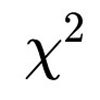
How would you massage the data in this Chi-squared test to both accept and reject the hypothesis?

Use your skill and knowledge to place various scientific lengths in order of size. Can you judge the length of objects with sizes ranging from 1 Angstrom to 1 million km with no wrong attempts?

How is the length of time between the birth of an animal and the birth of its great great ... great grandparent distributed?
Can you find the differential equations giving rise to these famous solutions?

On this page we give a selection of good starter activities for those new to NRICH

This group tasks allows you to search for arithmetic progressions in the prime numbers. How many of the challenges will you discover for yourself?

We asked what was the most interesting fact that you can find out about the number 2009. See the solutions that were submitted.
Show that even a very powerful spaceship would eventually run out of overtaking power

Imagine different shaped vessels being filled. Can you work out what the graphs of the water level should look like?
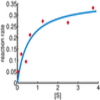
Can you construct a cubic equation with a certain distance between its turning points?
Various solids are lowered into a beaker of water. How does the water level rise in each case?
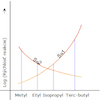
Explore the rates of growth of the sorts of simple polynomials often used in mathematical modelling.

How does the half-life of a drug affect the build up of medication in the body over time?
STEM students at university often encounter mathematical difficulties. This articles highlights the various content problems and the 7 key process problems encountered by STEM students.

This is the area of the advanced stemNRICH site devoted to the core applied mathematics underlying the sciences.

chemNRICH is the area of the stemNRICH site devoted to the mathematics underlying the study of chemistry, designed to help develop the mathematics required to get the most from your study of chemistry at A-level and university.

PhysNRICH is the area of the StemNRICH site devoted to the mathematics underlying the study of physics

engNRICH is the area of the stemNRICH site devoted to the mathematics underlying the study of engineering

This is the section of stemNRICH devoted to the advanced applied mathematics underlying the study of the sciences at higher levels
Things are roughened up and friction is now added to the approximate simple pendulum

Can you choose your units so that a cube has the same numerical value for it volume, surface area and total edge length?
In what ways can the pdfs of two normal distributions intersect?
The NRICH Stage 5 weekly challenges are shorter problems aimed at Post-16 students or enthusiastic younger students. There are 52 of them.
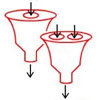
What functions can you make using the function machines RECIPROCAL and PRODUCT and the operator machines DIFF and INT?

Estimate these curious quantities sufficiently accurately that you can rank them in order of size
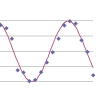
10 graphs of experimental data are given. Can you use a spreadsheet to find algebraic graphs which match them closely, and thus discover the formulae most likely to govern the underlying processes?
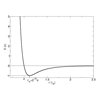
Investigate why the Lennard-Jones potential gives a good approximate explanation for the behaviour of atoms at close ranges

See how differential equations might be used to make a realistic model of a system containing predators and their prey.
An account of the various mathematical issues typically facing physics and engineering students at A-level and university.
Quick, practical ways in which you can help to make your classrooms and lessons maths-rich.

Many physical constants are only known to a certain accuracy. Explore the numerical error bounds in the mass of water and its constituents.

See how enormously large quantities can cancel out to give a good approximation to the factorial function.
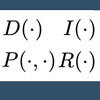
Can you hit the target functions using a set of input functions and a little calculus and algebra?

Investigate some of the issues raised by Geiger and Marsden's famous scattering experiment in which they fired alpha particles at a sheet of gold.

Explore the energy of this incredibly energetic particle which struck Earth on October 15th 1991

Investigate the effects of the half-lifes of the isotopes of cobalt on the mass of a mystery lump of the element.
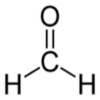
Investigate the molecular masses in this sequence of molecules and deduce which molecule has been analysed in the mass spectrometer.
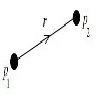
Can you arrange a set of charged particles so that none of them start to move when released from rest?
Dip your toe into the world of quantum mechanics by looking at the Schrodinger equation for hydrogen atoms

What does the empirical formula of this mixture of iron oxides tell you about its consituents?
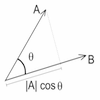
Explore the meaning of the scalar and vector cross products and see how the two are related.
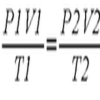
Explore how can changing the axes for a plot of an equation can lead to different shaped graphs emerging

Do each of these scenarios allow you fully to deduce the required facts about the reactants?
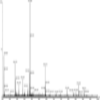
From the atomic masses recorded in a mass spectrometry analysis can you deduce the possible form of these compounds?
Look at the units in the expression for the energy levels of the electrons in a hydrogen atom according to the Bohr model.

Have you got the Mach knack? Discover the mathematics behind exceeding the sound barrier.

Ever wondered what it would be like to vaporise a diamond? Find out inside...
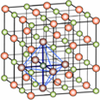
Unearth the beautiful mathematics of symmetry whilst investigating the properties of crystal lattices
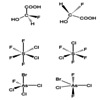
Put your visualisation skills to the test by seeing which of these molecules can be rotated onto each other.
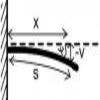
A preview of some of the beam deflection mechanics you will look at in the first year of an engineering degree

This problem is a sequence of linked mini-challenges leading up to the proof of a difficult final challenge, encouraging you to think mathematically. Starting with one of the mini-challenges, how many of the other mini-challenges will you invent for yourself?

This is a blank id used as a placeholder to indicate something is needed. Don't un-blank this id as it might be used in various places
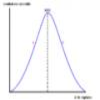
Several graphs of the sort occurring commonly in biology are given. How many processes can you map to each graph?

Use combinatoric probabilities to work out the probability that you are genetically unique!
Getting ready to start to study science, engineering or mathematics at university? Prepare yourself with these entertaining and thought-provoking mathematical challenges.
Helpful preparation for university for those intending to study biological sciences.

10 of our best problems to help you prepare to study chemistry at university.

Helpful preparation for university for those intending to study physical sciences.
Helpful preparation for university for those intending to study engineering.

Helpful preparation for university for those intending to study a course involving applied mathematics at university.
A useful entry point into the NRICH site for those students interested in Mathematical Olympiad problems or the Maths Challenges.

Explore the properties of matrix transformations with these 10 stimulating questions.

Explore the meaning behind the algebra and geometry of matrices with these 10 individual problems.
This page gives advice on mathematical preparation for students who will be coming to Cambridge University to study Natural Sciences.

Make a functional window display which will both satisfy the manager and make sense to the shoppers

Jennifer Piggott and Steve Hewson write about an area of teaching and learning mathematics that has been engaging their interest recently. As they explain, the word ‘trick’ can be applied to mathematical activity in many ways.

Steve has created two mappings. Can you figure out what they do? What questions do they prompt you to ask?

Calculate probabilities associated with the Derren Brown coin scam in which he flipped 10 heads in a row.
A weekly challenge: these are shorter problems aimed at Post-16 students or enthusiastic younger students. What has happened with my online integrator?

How many different colours of paint would be needed to paint these pictures by numbers?

How many different colours would be needed to colour these different patterns on a torus?

This black box reveals random values of some important, but unusual, mathematical functions. Can you deduce the purpose of the black box?

A weekly challenge: these are shorter problems aimed at Post-16 students or enthusiastic younger students.
A weekly challenge: these are shorter problems aimed at Post-16 students or enthusiastic younger students.

A weekly challenge: these are shorter problems aimed at Post-16 students or enthusiastic younger students.
A weekly challenge: these are shorter problems aimed at Post-16 students or enthusiastic younger students.

A weekly challenge: these are shorter problems aimed at Post-16 students or enthusiastic younger students.

Third in our series of problems on population dynamics for advanced students.
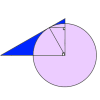
A weekly challenge concerning trigonometry, circles and triangles.
A weekly challenge: these are shorter problems aimed at Post-16 students or enthusiastic younger students.
A weekly challenge: these are shorter problems aimed at Post-16 students or enthusiastic younger students.
A weekly challenge: these are shorter problems aimed at Post-16 students or enthusiastic younger students.
A weekly challenge: these are shorter problems aimed at Post-16 students or enthusiastic younger students.
A weekly challenge: these are shorter problems aimed at Post-16 students or enthusiastic younger students.
A weekly challenge concerning the interpretation of an algorithm to determine the day on which you were born.

A weekly challenge: these are shorter problems aimed at Post-16 students or enthusiastic younger students.
A weekly challenge: these are shorter problems aimed at Post-16 students or enthusiastic younger students.

A weekly challenge: these are shorter problems aimed at Post-16 students or enthusiastic younger students.
Can you crack these very difficult challenge ciphers? How might you systematise the cracking of unknown ciphers?
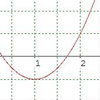
Get started with calculus by exploring the connections between the sign of a curve and the sign of its gradient.

Mathmo is a revision tool for post-16 mathematics. It's great installed as a smartphone app, but it works well in pads and desktops and notebooks too. Give yourself a mathematical workout!
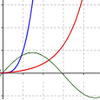
A weekly challenge: these are shorter problems aimed at Post-16 students or enthusiastic younger students.

A weekly challenge: these are shorter problems aimed at Post-16 students or enthusiastic younger students.

Second in our series of problems on population dynamics for advanced students.
Our first weekly challenge. We kick off with a challenge concerning inequalities.
Investigate the relationship between speeds recorded and the distance travelled in this kinematic scenario
A selection of intriguing questions to consider on mechanics, particularly surrounding the ideas concerning impulse and momentum.

Find the relationship between the locations of points of inflection, maxima and minima of functions.
Helpful preparation for those intending to study a course involving pure mathematics at university.
A selection of interesting mathematics challenges which pave the way to the applied mathematics of greatest use at university.

This problem opens a major sequence of activities on the mathematics of population dynamics for advanced students.

Fourth in our series of problems on population dynamics for advanced students.

An advanced mathematical exploration supporting our series of articles on population dynamics for advanced students.
This is the area of the stemNRICH site devoted to the core applied mathematics underlying the sciences.
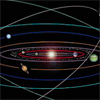
Make an accurate diagram of the solar system and explore the concept of a grand conjunction.

The Living World is the section of stemNRICH - secondary designed to enhance the study of the science of living things for ages 11 to 16
PhysNRICH is the area of the StemNRICH site devoted to the mathematics underlying the study of physics

Sixth in our series of problems on population dynamics for advanced students.
Find out why water is one of the most amazing compounds in the universe and why it is essential for life. - UNDER DEVELOPMENT

Fifth in our series of problems on population dynamics for advanced students.

Work with numbers big and small to estimate and calculate various quantities in biological contexts.
Consider these weird universes and ways in which the stick man can shoot the robot in the back.

Work with numbers big and small to estimate and calculate various quantities in physical contexts.
What's the chance of a pair of lists of numbers having sample correlation exactly equal to zero?
Find the smallest value for which a particular sequence is greater than a googol.

The active Stage 5 problems. Why not submit a solution or chat about things on the blogs?

This articles describes how school teachers can help to prepare students for STEM courses at university

A weekly challenge concerning the decay of medicines in the body.

An advanced mathematical exploration supporting our series of articles on population dynamics for advanced students.
Here we present a collection of NRICH problems which will be of use and interest to those hoping to study economics at university.

Have you ever wondered what it would be like to race against Usain Bolt?
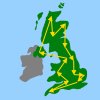
Imagine you had to plan the tour for the Olympic Torch. Is there an efficient way of choosing the shortest possible route?
This page contains information for the teachers helping with the development of stemNRICH at KS3 and 4

How do different drug-testing regimes affect the risks and payoffs for an athlete who chooses to take drugs?
Why might you wish to study science at university? Read about the views of current students! UNDER DEVELOPMENT
Explore the properties of this different sort of differential equation.
The NRICH workouts give you practice in the core skills needed to become really proficent at your mathematics.

Under which circumstances would you choose to play to 10 points in a game of squash which is currently tied at 8-all?

See how little g and your weight varies around the world. Did this variation help Bob Beamon to long-jumping succes in 1968?

Here we look back at the year with NRICH and suggest mathematical summer holiday activities for students, parents and teachers.

In which Olympic event does a human travel fastest? Decide which events to include in your Alternative Record Book.

Can you work out what simple structures have been dressed up in these advanced mathematical representations?

This problem explores the biology behind Rudolph's glowing red nose.
How might you use mathematics to improve your chances of guessing the number of sweets in a jar?
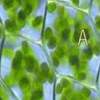
Maths is everywhere in the world! Take a look at these images. What mathematics can you see?

Analyse these beautiful biological images and attempt to rank them in size order.

Explore creating 'factors and multiples' graphs such that no lines joining the numbers cross

Give your further pure mathematics skills a workout with this interactive and reusable set of activities.

Play the game of Poison, Antidote, Water to start to understand the mathematics of associativity and groups.

Can you drive a pointer using LOGO to create a simple version of the Olympic Rings logo?
Games most suitable for Stage 1 and 1 children and their parents and carers te play.

A collection of articles suitable for Stage 1 and 2 children and their parents and carers.

First in our series of problems on population dynamics for advanced students.

This is our collection of tasks on the mathematical theme of 'Population Dynamics' for advanced students and those interested in mathematical modelling.

Explore the properties of these two fascinating functions using trigonometry as a guide.
Can you deduce the familiar properties of the sine and cosine functions starting from these three different mathematical representations?
4: Introducing and developing STEM in the classroom.
5: Introducing and developing STEM in the classroom.
One of the articles supporting STEM teaching in the classroom.
7: Introducing and developing STEM in the classroom.

A collection of problems related to the mathematics of fundamental physics.
This article reports on a brief study concerning the algebraic fluency of highly performing UK mathematics students
Read about Steve Hewson's research project on exceptional mathematicians.
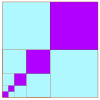
Sequences are everywhere in mathematics! In these problems you can explore some sequences, learn how to represent them, and how to calculate sums of series.
Sequences are everywhere in mathematics! In these problems you can explore some sequences, learn how to represent them, and how to calculate sums of series.

Stage 5 statistics, mechanics and decision mathematics material organised by topic
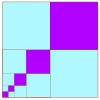
These problems for Stage 4 and 5 students look at more challenging sequences and introduce the idea of series summation.

Resources to support the teaching and learning of stability and equilibrium in mechanics
A blank resource used for development purposes, such as putting in a header

This is our secondary collection of favourite mathematics and sport materials.

Games and computer room activities suitable for secondary school students

This collection of articles gives introductions to important topics in advanced mathematics

This collection of articles describe the lives of famous mathematicians along with the historical development of mathematical ideas.

An epsilon: short to state, clearly defined and intriguing to those with a mathmo frame of mind.
An epsilon: short to state, clearly defined and intriguing to those with a mathmo frame of mind.

Discover how different mathematical representations can help us to understand mathematical objects.

Explore the ways that mathematics can be used to model and analyse different scenarios.

Hone your skills of mathematical enquiry and conjecture.

Develop your skills of mathematical argument and proof.
Interested in programming? Try your hand at these mathematically rich programming tasks.
Do your remember the mathematics books from your time in sixth form? We'd love to hear about them.
Have you made an interesting discovery in mathematics? Want to share your investigation? Here is the place to do it.
In this beautifully written-up investigation Abhay describes his discovery of a 'theory of cycles'.