Sticky Numbers
Why do this problem?
This problem requires some knowledge of square numbers, but
more importantly requires students to think strategically and
provide convincing arguments and justifications for their
findings.
Possible approach
Introduce the problem using the example $10, 15, 21, 4, 5$,
explaining that this list of numbers is special because each pair
of adjacent numbers add up to make a square number.
Set them the challenge to produce a similar list using all the
numbers from $1$ to $17$. Hand out sets of
these cards and ask students
to work in pairs on this challenge.
After the class have had a few minutes to work on this, add that
you would like to know all
the possible different ways of making such a list. Challenge them
to produce a convincing argument that they have found all the
possibilities.
Finally, ask students to present their solutions and justifications
to the rest of the class.
An alternative starting point for this lesson could be to ask for
17 volunteers to stand at the front holding one of these cards.
With help from the rest of the class, ask them to arrange
themselves to satisfy the criteria above. Once they have found a
solution, ask them to work in pairs as outlined above to find all
the possible arrangements and justify that they have the complete
set.
Key questions
Are there any numbers which cannot be linked to another
number?
Are there any numbers which can only link to one other
number?
Are there any numbers which can only link to two
numbers?
Are there any numbers which can link to more than two
numbers?
How do you know you've found every possible solution?
Possible extension
This graph has the numbers from $1$ to $31$ at its vertices.
Each edge connects two numbers which add together to make a square
number.
Can you use the graph to produce a list of all the numbers from $1$
to $31$ so that pairs of adjacent numbers add up to a square
number? Is there more than one way to do it?
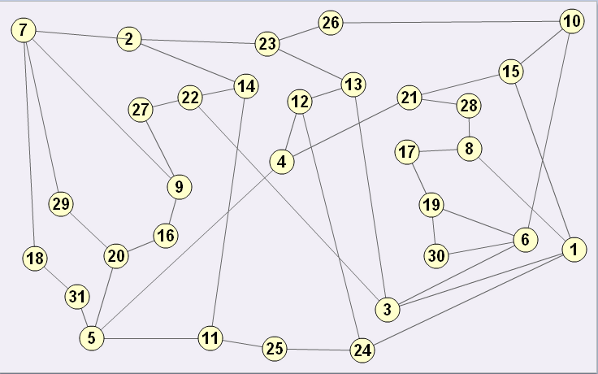
Can you find any other numbers $n$ less than $31$ so that all the
numbers from $1$ to $n$ can be written in a list in this way? How
does the graph help you? Here is a printable version
of the graph.
Possible support
Suggest that students could make a table listing the numbers which
can be paired with each of the numbers from $1$ to $17$ to make a
square total.