Paper Curves
Why do this problem?
This
problem offers a
novel way of exploring connections between Mathematics and Art. It
is important for learners to have plenty of opportunity to discuss
with others and to verify ideas.
Possible approach
Some groups of children
may need a demonstration by an adult, particularly to ensure good
folding and creasing as you work through the instructions given.
Encouraging them to work in pairs will mean they can help each
other produce the folds and they also have someone with whom to
talk.
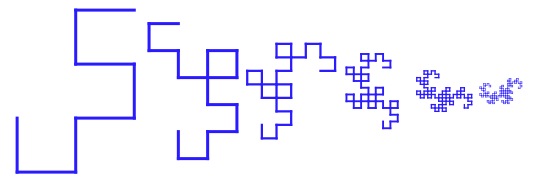
(For checking purposes,
this image
shows the progression in folds from the third to the eighth.)
In fact, this series of
folds produces what is known as a 'dragon curve'. It will be
interesting to see whether any children observe the dragon shape.
They are likely to be fascinated and amused by the fact that it has
been investigated by several mathematicians!
Key questions
What do you see?
Does it look like
anything?
What could you try
now?
Possible extension
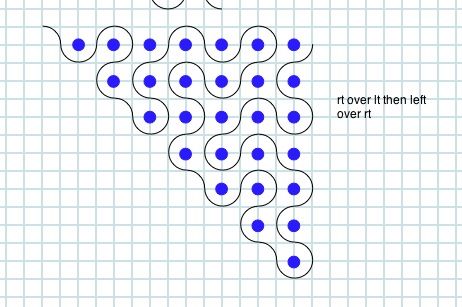
Try slightly different
alternatives like folding right over left and then left over right
etc. Ask pupils to predict whether the result will be the same or
different and why.
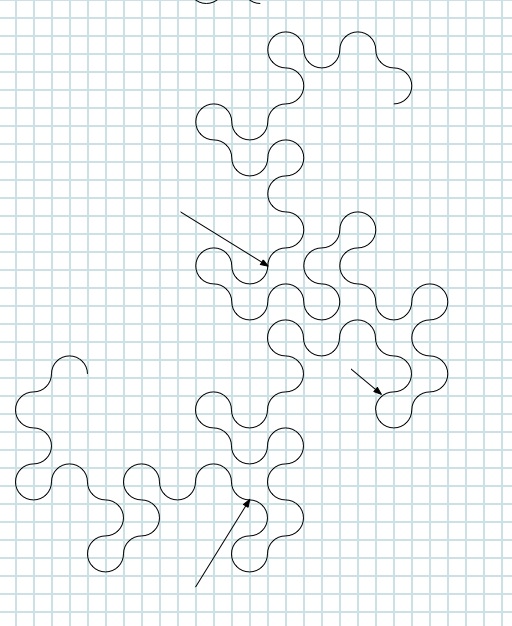
Drawing on a computer may
be enhanced by producing a curved turn rather a right angle. Five
folds using right over left then left over right produced the
following:
Some pupils may like to
go further by looking at the successive mid-points:
Possible support
Some pupils may require
adult help with the manipulative skills of folding and
creasing.