Weekly Challenge 7: Gradient Match
There are various intuitive ways to think
about such results but creating really clear arguments is somewhat
more difficult. The descriptions given here do not constitute
proofs as such, but do introduce advanced analytical ways of
thinking which are refined at university.
Consider the first case; the others are similar.
Clearly the special case of the curve joining the two points $(0,
0)$ and $(8, 8)$ with a straight line has gradient $1$ everywhere.
Any other curve between these two points can be considered as a
deformed version of this line. Wherever the curve is deformed
outwards point bulges will necessarily occur. Imagine dragging the
line $y=x$ up or down. It will cut through each bulge but
eventually pass out of each bulge. As it passes out of each bulge
it will touch each bulge at a single point. These are the points
with gradient 1.
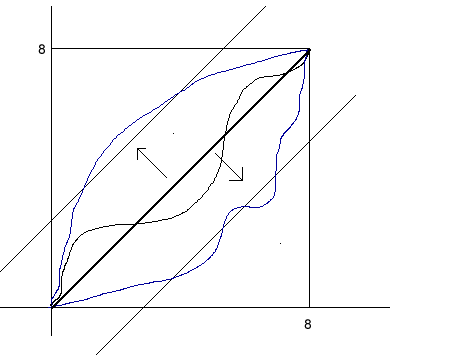
Analytical proofs proceed along
these sorts of lines:
Sketch: Imagine the curve
being sketched starting from the origin. Imagine that the gradient
of your curve is always less than or equal to some number $M$ which
satisfies $M< 1$. Then in $8$ units of $x$ the $y$ value of the
curve can increase by at most $8M$, which is less than $8$. Thus,
it could not pass through the point $(8, 8)$; therefore the maximum
achieved gradient cannot be less than $1$. Similarly the minimum
achieved gradient cannot be greater than $1$. It is thus
intuitively clear that a gradient of $1$ is achieved
somewhere.