Count the Digits
We had quite a few responses from pupils who
had found out things by exploring this situation. Calum,
Christopher and Matthew from St. Andrews in Scotland wrote to
say:
We found out that using the digits $1, 2$ and $3$ making a
four-digit number you would start doubling eventually when you
reach line $10$ every time no matter what order you put the digits
in.
We found out that using the digits $1, 2$ and $4$ making a
four-digit number you would start doubling eventually when you
reach line $7$ every time no matter what order you put the digits
in.
We found out that using the digits $1, 3$ and $4$ making a
four-digit number you would also start doubling eventually when you
reach line $7$ every time no matter what order you put the digits
in.
We found out that using the digits $2, 3$ and $4$ making a
four-digit number you would start doubling eventually when you
reach line $6$ every time no matter what order you put the digits
in.
Sayeed from St. Michael's London also
sent in a well thought out reponse:-
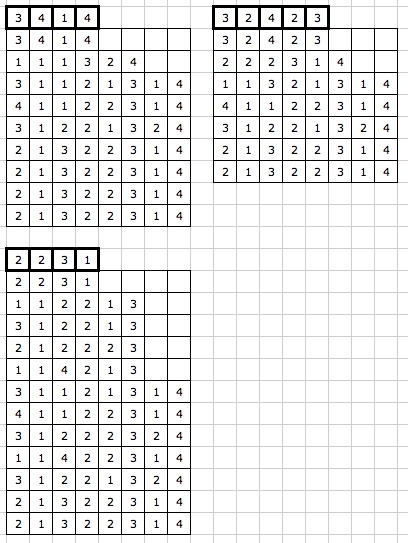
This is my answer when starting with $4$ digits:
$3243, 122314, 21221314, 31321314,
31123314, 31123314$
It will continue as the same number forever.
I notice: Each row has two more digits then the previous row
until the rows have the maximum amount of digits ($8$) possible. In
each row with the maximum digits, the second digit always has a
$1$, the fourth digit always has a $2$, and the sixth digit always
has a $3$ and so on. Every row ends in $14$ excluding the starting
row. This is my answer when starting with $5$ digits:
$22411, 212214, 213214, 21221314,
31321314, 31123314, 31123314$
It will continue as the same number forever.
I notice the same thing that happens with the starting $4$ digit
row except the rows getting two more digits each time until there
are maximum digits. I also notice that with the starting four digit
row it takes four counts till the number continues as the same
number forever. But for the starting five digit row it takes five
counts till the number continues as the same number forever!
Thomas from Colet Court School said the
following and attached his numbers.
When you start with $4$ digits the series converges to $21322314$
whatever the first $4$ digits. When you start with $5$ digits
it gives the same result.
Finally, Miss Stanley's Numeracy group from
Greystoke Leicester wrote:-
We liked this challenge and worked very hard. Trying other
numbers using the same rules we found that we could continue until
the numbers were the same, because that number would keep
repeating. We discovered some have shorter sequences and some have
longer sequences until the same number repeats, but we're not sure
why yet.
Caitlin and Millie found that some numbers ($4122$) didn't
seem to have an end because we spotted the pattern that it kept
repeating itself, so we decided to stop. Some of us even moved onto
extending this challenge to $5, 6$,and even $7$ digits.
Many of us spotted that the larger the number of digits in the
starting number, the shorter the sequence was to get to the
end.
Thank you, we enjoyed this challenge.
Well done to all the contributors,
it sounds as if you really enjoyed this. (A late arrival came from
Adam at Cypress School who noted something special about $1$ &
$4$. I am wondering if that was because it was not a usual
thing you'd find going on in many Mathematics lessons? On the last
day of the month we recieved this excellent presentation of Oscar
from Spain.
You have to take out one digit of the $1,2,3,4$ which are the
possible digits to make the starting number. If you take out a
number and want to get a $4$ digit number, you have to repeat one
of the other $3$ numbers. If you take out $1$, you have possible
starting numbers
$2234, 2334, 2344$ and other possible numbers that you get
changing the order of the digits in each of those $3$
numbers.
As the order does not affect digit counting, those give the
same counting sequence. The counting is:
$A 2 B
3 C 4$
and A-B-C have to be $2-1-1$ (for $2234$) or $1-2-1$ (for
$2334$) or $1-1-2$ (for $2344$).
The next counting in all cases is $2 1 2 2 1 3 1 4$ and
sequence is:
$3 1 3 2 1 3 1 4$
$3 1 1 2 3 3 1 4$ and this last number stays the same if you
count the digits. If you take out $2$ you get the number:$ 2 1 3 2
2 3 1 4$ If you take out $3$ you get the same as if you take out
$1$, and if you take out $4$ you get the same as if you take out
$2$.