More Children and Plants
From notes of Plants
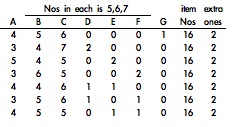
So if pupils consider the areas D, E, F and G as "worth" more than
1, (D, E, F being 2 and G 3), then tables like this can sometimes
result. There's a lot to explore in these tables, and it's
interesting at the start to find out how the pupils do the
explorations to get the table. Some may be using a spreadsheet,
mental calculations, looking at the picture of three overlapping
circles whilst others may use something practical to check that all
is well with their ideas. Some interesting discussions may arise
from some pupils who work very arithmetically and come up with a
system but unfortunately ignore the maximum number allowed in each
circle. B/ Explore other groups of numbers instead of just 5, 6 and
7 - what about numbers going up in 2s, 4s, 6s and 8s or just random
numbers 3s, 6s and 7s? C/ If pupils have happily constucted tables
like those above in which every possibility is discovered you might
explore the number of possibilities according to the difference
between the total for the three circles, (5+6+7) and the number of
items used. For example there were 7 solutions for a difference of
two.
Further exporation will reveal the number of solutions when 3,
4, 5 etc extra ones are needed (e.g. when 13 items are used with 5,
6 and 7 circles then there an extra (18 - 13) 5 items are
needed.
For the highest-attaining Obvious extension work can be looked
at by considering four areas - though not all are circles in this
diagram - and asking similar questions.