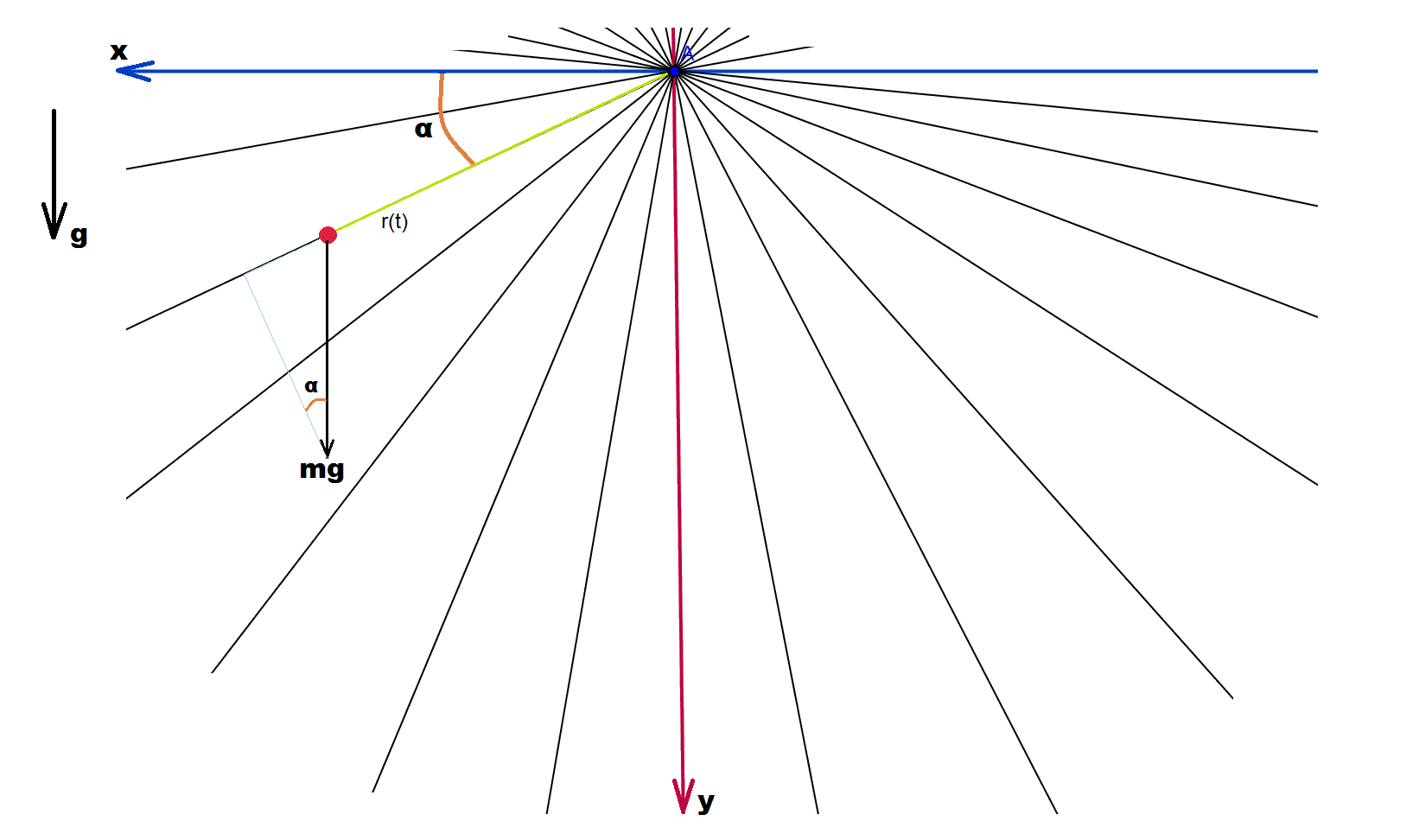
First of all let's choose a convenient Cartesian coordinate system as shown in the picture and suppose that the bead which is sliding through the needle inclined at an angle $\alpha$ to x-axis is at distance $r(t)$ from the origin.
The gravity force is acting on the bead and it makes the bead accelerate along the needle. Write II-Newton's law in the direction along the needle and in the direction perpendicular to the needle.
$ma = mg\sin(\alpha)$
$0 = N - mg\cos(\alpha)$ where $N$ is a reaction force.
Beads start from rest, so $r(t) = \frac{at^2}{2} = \frac{g\sin(\alpha) t^2}{2}$.
Change the polar coordinates to Cartesian coordinates by substituting $r = \sqrt{x^2 + y^2}$ and $\sin(\alpha) = \frac{y}{\sqrt{x^2 + y^2}}$.
$$\sqrt{x^2 + y^2} = \frac{y}{\sqrt{x^2 + y^2}}\frac{gt^2}{2}$$ Multiply both sides by $\sqrt{x^2 + y^2}$ and complete the square.
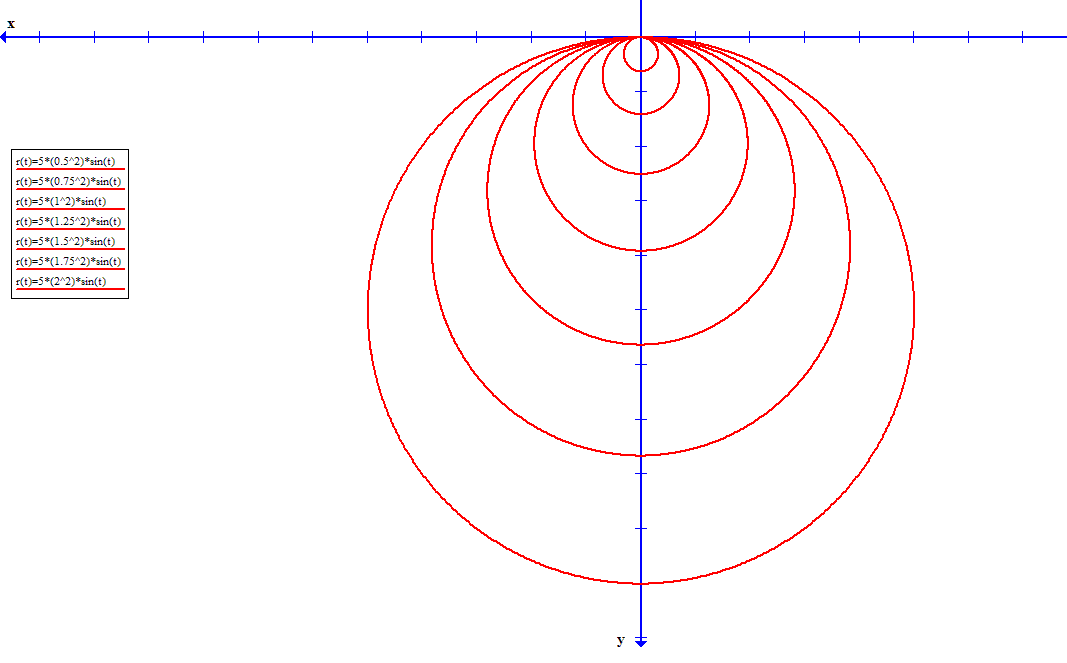
$$x^2 + (y -\frac{gt^2}{4})^2 = (\frac{gt^2}{4})^2$$
$ma = mg\sin(\alpha) -\mu N$
$0 = N - mg\cos(\alpha)$ where $N$ is a reaction force. $\therefore$
$$a = g(\sin(\alpha) - \mu\cos(\alpha))$$ It is important to notice that if $a < 0$ then the bead is not even starting to slide. Thus, the beads will slide for $\alpha$ from $\tan^{-1}(\mu)$ to $(\pi - \tan^{-1}(\mu))$. To simplify the situation, notice that the shape will be symmetrical in the y-axis. Thus, we need to analyse what happens for $\alpha$ from $\tan^{-1}(\mu)$ to $\frac{\pi}{2}$. $$r(t) = \frac{at^2}{2} = (\sin(\alpha) - \mu \cos(\alpha)) \frac{gt^2}{2}$$ Change to the Cartesian coordinate system $x^2 + y^2 = \frac{gt^2}{2} (y - \mu x)$ for $\frac{\pi}{2} > \tan^{-1} (\frac{y}{x}) > \tan^{-1} (\mu)$. Complete the squares to get
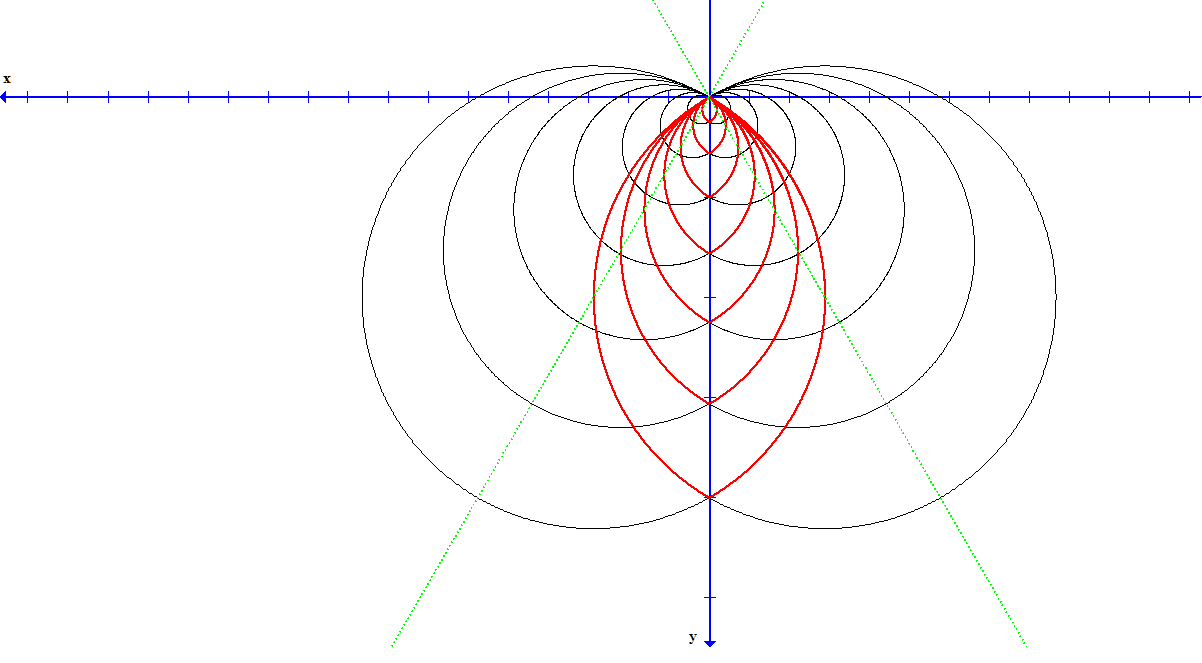
$$(x + \frac{\mu gt^2}{4})^2 + (y - \frac{gt^2}{4})^2 = (1+ \mu^2)(\frac{gt^2}{4})^2$$ It is easier to plot a whole circle and then to take a suitable arc. Similarly, to reflect a circle in y-axis change $x$ to $-x$ then we have an equation $$(-x + \frac{\mu gt^2}{4})^2 + (y - \frac{gt^2}{4})^2 = (1+ \mu^2)(\frac{gt^2}{4})^2$$ and we take a suitable arc again. Let's take $\mu = \frac{\sqrt3}{3}$ then $\tan^{-1}(\frac{\sqrt3}{3}) = \frac{\pi}{6}$. We plot circles which help to show how the shape of beads in red changes. These graphs represent the shape of beads after time 0.5 s, 0.75 s, 1 s, 1.25 s, 1.5 s, 1.75 s, 2 s. Circles are traveling along green lines which equations can be found knowing that the coordinates of center is $(\frac{\mu gt^2}{4}, \frac{gt^2}{4}) = \frac{gt^2}{4}(\mu, 1)$ and $\frac{gt^2}{4}(-\mu, 1)$
To sum up: