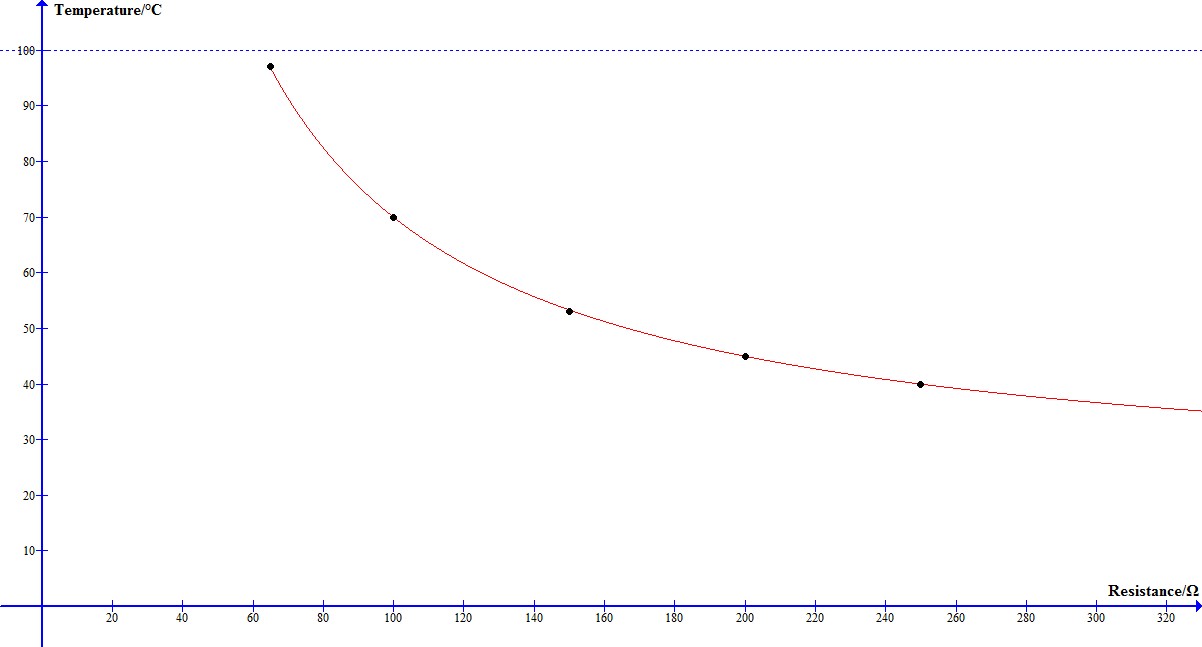
1. The temperature in the kettle settles down because dissipated heat in the heating element is equal to heat which is lost through walls of the kettle.
2.
3. It is a graph of a reciprocal function. The function is of the form T = T0 + C/R. We use two given points (100, 70), (250, 40) to get two equations:
70 = T0 + C/100 (1)
40 = T0 + C/250 (2)
Subtracting (2) from (1) we have 70 - 40 = C/100 - C/250 which gives C = 5000 and using (1) we have that T0= 70-50 = 20. Hence we have the function T = 20 + 5000/R.
4. To find the temperature of the room we need to model the system such that a heating element is not being heated. This means we let R be sufficiently large because to make R really small is not realistic. Thus, from the previous equation the temperature of the room is T0 = 20.
5. We notice that as the resistance is small the temperature is really high. Above a water boiling temperature, this means that there would be vapor. So, this equation is not suitable for small values of resistance. We also should take into consideration the resistance of wires.
6. It should be related linearly by the definition of specific heat capacity.
Extension.
Method 1. Try to make a table noting that the voltage is constant and it only scales the power.
| R/$\Omega$ | $R/(r+R)^2$$\times \Omega$ |
| 1 | 0.0278 |
| 2 | 0.0408 |
| 3 | 0.0469 |
| 4 | 0.0494 |
| 5 | 0.0500 |
| 6 | 0.0496 |
| 7 | 0.0486 |
| 8 | 0.0473 |
| 9 | 0.0459 |
| 10 | 0.0444 |
We see that a maximum is reached is near 5 $\Omega$. Lets make another table to explore values which are close to 5 $\Omega$.
| R/$\Omega$ | $R/(r+R)^2$$\times \Omega$ |
| 4.8 | 0.049979 |
| 4.9 | 0.049995 |
| 5.0 | 0.050000 |
| 5.1 | 0.049995 |
| 5.2 | 0.049981 |
Thus, we conclude that we have a maximal power when R = 5 $\Omega$. It is equal to
$P = 5\times 240^2 : (5+5)^2 = 2880 W$.
Method 2. Try to plot the function and find the maximum by drawing the line which is perpendicular to x-axis and then estimate the resistance at that point.
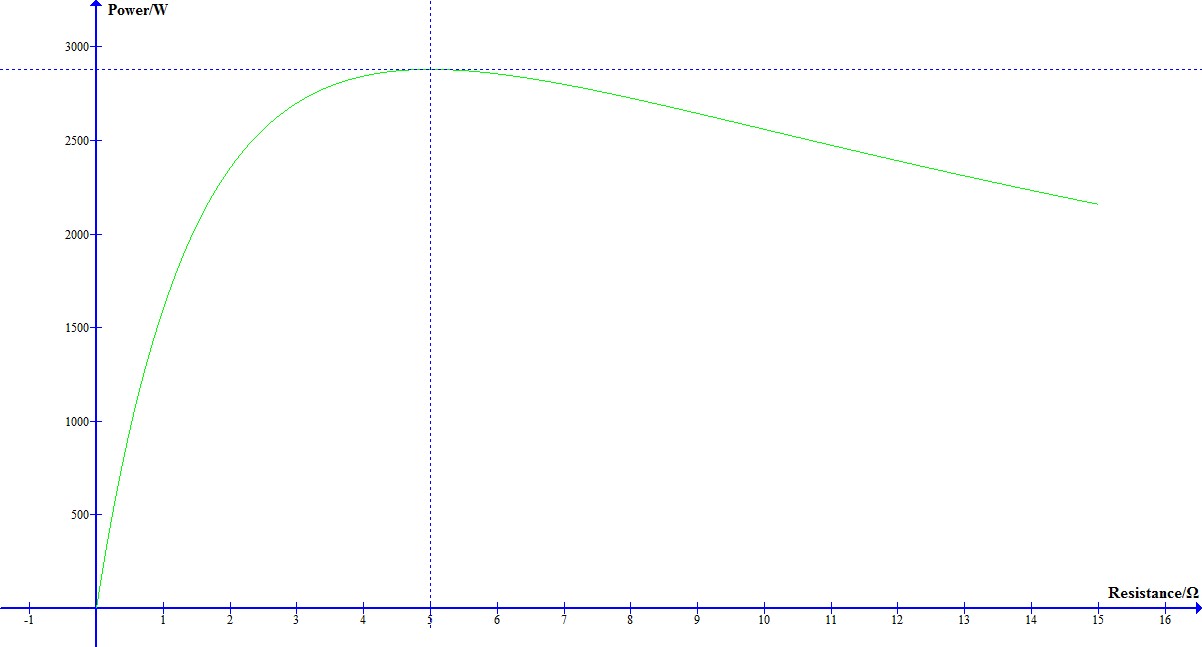
Method 3. Write the function as a quadratic equation with respect to R:
$$R^2+ (2r - \frac{V^2}{P})R + r^2 = 0$$ The critical point will correspond to a discriminant being zero. Thus $$D = (2r - \frac{V^2}{P})^2 - 4r^2 = 0$$ We get that $$P = \frac{V^2}{4r}$$ Plug back to the equation the expression of P to get that $(R-r)^2 = 0$. So, R = r = 5 $\Omega$.
Generally we have that the power is maximal when the external resistance is equal to the internal resistance. R = r and $P = \frac{V^2}{4r}$.
Method 4. Straight differentiation: finding the maximum point ($\frac{dP}{dR}$ = $0$)
$P$ = $\frac{RV^{2}}{(r+R)^{2}}$
By using the chain rule:
$\frac{d(vu)}{dy}$ = $v\frac{du}{dy} + u\frac{dv}{dy}$