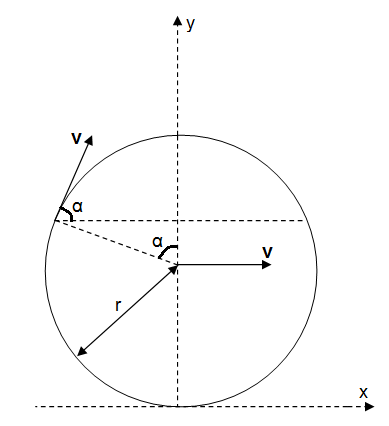
As suggested in the hint it is useful to choose the coordinate system with the origin at the wheel touching the ground point. The wheel is moving horizontally with the speed $v = 18$km/h = $5$m/s and the diameter of the wheel $d = 23$ inch $= 0.584$m. Note $r = d/2$. The wheel is not slipping on the ground, thus the linear speed of the drops on the wheel is $v = 5$m/s. Suppose that the drop detaches when it is at an angle $\alpha$ with vertical.
In x direction: $x(t) = -r\sin(\alpha) + vt + vt\cos(\alpha)$
In y direction: $y(t) = r + r\cos(\alpha) + vt\sin(\alpha) - \frac{gt^2}{2}$
We neglect any air resistance then the drop will be at its highest point when its vertical speed is zero.
$0 = v\sin(\alpha) - gt_{max}$. Hence, $t_{max} = \frac{v\sin(\alpha)}{g}$. We substitute this expression to the y direction equation to get that
$y(\alpha) = r(1 + \cos(\alpha))+\frac{v^2\sin(\alpha)^2}{g}-\frac{v^2\sin^2(\alpha)}{2g} = r(1 + \cos(\alpha)) +\frac{v^2\sin^2(\alpha)}{2g}$.
Method 1. Differentiate y with respect to alpha and then solve $\frac{dy}{d\alpha} = 0$. Remember that $\frac{d\sin(\alpha)}{d\alpha} = \cos(\alpha)$ and $\frac{d\cos(\alpha)}{d\alpha} = -\sin(\alpha)$. We can use chain rule to differentiate $\sin^2(\alpha)$:$\frac{d\sin^2(\alpha)}{d\alpha} = \frac{d\sin^2(\alpha)}{d\sin(\alpha)}\frac{d\sin(\alpha)}{d\alpha} = 2\sin(\alpha)\cos(\alpha)$. Moreover if C is constant $\frac{dC}{d\alpha} = 0$. Thus, $\frac{dy}{d\alpha} = 0 - r\sin(\alpha) + \frac{v^2}{2g}2\sin(\alpha)\cos(\alpha)$. This means that either $\sin(\alpha) = 0$ or $\cos(\alpha) =\frac{gr}{v^2}$ for $\frac{gr}{v^2} < 1$. If $\sin(\alpha) = 0$ then $\cos(\alpha) = 1$ or $-1$, $y_{max} = 2r = 0.584$m or $0$. If $\cos(\alpha) =\frac{gr}{v^2}$ for $\frac{gr}{v^2} < 1$ then $y_{max} = r(1+\frac{gr}{v^2}) + \frac{v^2}{2g}(1 -\frac{g^2r^2}{v^4}) = r + \frac{v^2}{2g} + \frac{gr^2}{2v^2} = 1.58$m. So, the maximum height is $1.58$m.
Method 2. Use identity $\sin^2(\alpha) = 1 - \cos^2(\alpha)$ and note $X = \cos(\alpha)$. Then $y(X) = r + rX + \frac{v^2}{2g} - \frac{v^2}{2g}X^2$ which is a quadratic and the critical point can be found. Try it!
Find the x coordinate of the drops when they are at the highest point.
$x_{max} = -r\sin(\alpha) + vt(1 + \cos(\alpha)) = -r\sin(\alpha) + v\frac{v\sin(\alpha)}{g}(1 + \cos(\alpha)) = \sin(\alpha)(\frac{v^2}{g}(1 + \cos(\alpha)) - r)$ $x_{max}= \sqrt{1 - \frac{g^2r^2}{v^4}}(\frac{v^2}{g}(1 + \frac{gr}{v^2}) -r) =\frac{v^2}{g} \sqrt{1 - \frac{g^2r^2}{v^4}}$.
The coordinate of the wheel axle is $x_{axle} = vt = v\frac{v\sin(\alpha)}{g} = \frac{v^2}{g} \sqrt{1 - \frac{g^2r^2}{v^4}}$. Thus, $x_{axle} = x_{max}$. The drops are just above the wheel axle.