The Big Cheese
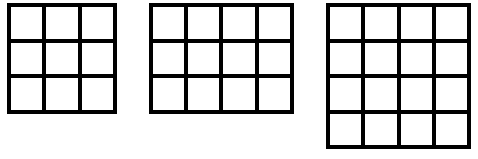
[3 slices B]
We can take the 3 by 4 and split it into two triangular
pieces:
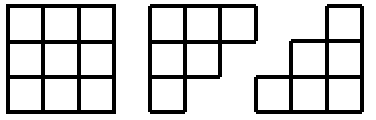
[Sq2TriA]
Each of these triangular pieces can be placed on two adjacent side
of the 3 by 3 square:
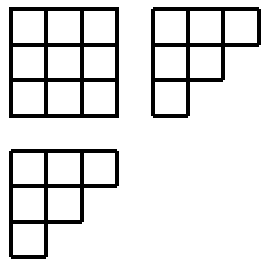
[Sq2TriB]
When put together we have a large triangular shape using 21 little
squares, and of course 21 is a triangular number.
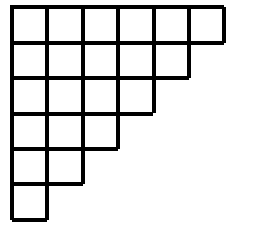
[Sq2TriC]
For the more able or older pupils there is much to explore -
particularly if you are able to extend the cheese to a 20 x 20 x 20
block - the following could be good doors to open:
1/ Looking at the total sizes of
slices that will follow (eg for the 5 x 5 x 5 it will be adding the
1, 1, 2, 4, 4, . . . . 20, 25 and getting 125), but considering
consecutive sizes of starting blocks.
2/ Consider the surface areas of
the slices that are cut off.
3/ Examine the total surface areas
of the slices that will come from a particular block and then
considering consecutive sized blocks.
4/ Think of the block that is left
after a slice has been taken and look at its surface area.
5/ With all of these "patterns" it
is good (in fact rather exciting!) to look at the Digital
Roots!
6/ Each time you look at a new
sized block (e.g. the 8 x 8 x 8) looking at how, when all the
slices have been cut, you can share out the slices to give an equal
amount to the (8)people.
Here's a spreadsheet and a bit of explanation of the
columns.
A is the size of the starting cube of cheese B,
C is the size of successive slices to be removed - as B by C
being the "cut" area
D is the area that was cut through E is the digital root of
column D
F is the volume that we'll get when all the slices have been
cut, starting from here
G is the digital root of column F
H is the surface area of the slice taken
I is the total surface area of all the slices to come starting
from here
J, L, N are parts of I written out separately with
K, M and O being the digital roots
P is the surface area of the block that is left when the
latest slice has been cut
Q, R, S are the digital roots of P split up.
[Spread A]
[Spread B]
REMOVED FROM ORIGINAL PROBLEM AFTER ALL THE CUTS WERE MADE;
So we had cut off in order:- a 5 by 5; 4 by 5; 4 by 4; 4 by 4; 3 by
4; 3 by 3; 3 by 3; 2 by 3; 2 by 2; 2 by 2; 2 by 1; 1 by 1 and
you're left with a 1 by 1. When these slices are laid down their
top surface measures :- 25, 20, 16, 16, 12, 9, 9, 6, 4, 4, 2, 1,
and 1 left at the end. I felt that this series of numbers could
well be worth exploring. So why don't you have a go too! You might
find it useful to write them in the opposite order going up instead
of going down. 1, 1, 2, 4, 4, 6, 9, 9, 12, 16, 16, 20, 25 . . . . .
As well as looking at the numbers, you might like to use cubes,
like I did and then make the 13 cuboids. Some ideas to try:-
Investigate trying to share these 13 pieces out so that everyone
gets an equal share. Try using the 13 cuboids to re-construct the 5
by 5 by 5 cube and explore different ways of doing that!! What
about the surface area of each of the 13 slices? What about the
surface area of the big block after each slice has been cut off.
What about . . . . . . . . ? I guess that once you've explored the
pattern of numbers you'll be able to extend it as if you had
started with a 10 by 10 by 10 cube of cheese.
There are lots of answers to this problem, depending on what
questions you choose to ask. Have a go yourself, and if you
discover anything interesting, let us know what you've done! Please
don't worry that your solution is not "complete" - we'd like to
hear about anything you have tried. Teachers - you might like to
send in a summary of your children's work.