Clone of What Numbers Can We Make?
We received some well considered solutions
to this problem.
Tom and Freya from Ide Primary School found
five ways of making 16 using four numbers:
7+7+1+1=16
5+5+3+3=16
7+3+3+3=16
5+7+3+1=16
5+5+5+1=16
Daniel from Staplehurst School found
that it was impossible to make 25 with six odd numbers and
then went on to list the possible totals that could be made from
selecting three, four, five or six numbers from the set of bags
below. Here is a summary of his findings.
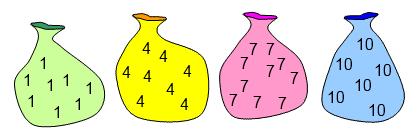
Brandyn from
Garden International School started by exploring this set of bags
and then considered other sets of bags:
Choosing just three numbers from the
bags above gave the following totals, all multiples of 3:
| 1 |
4 |
7 |
10 |
TOTAL |
| 3 |
|
|
|
3 |
| |
3 |
|
|
12 |
| |
|
3 |
|
21 |
| |
|
|
3 |
30 |
| 2 |
1 |
|
|
6 |
| 2 |
|
1 |
|
9 |
| 2 |
|
|
1 |
12 |
| 1 |
2 |
|
|
9 |
| |
2 |
1 |
|
15 |
| |
2 |
|
1 |
18 |
| 1 |
|
2 |
|
15 |
| |
1 |
2 |
|
18 |
| |
|
2 |
1 |
24 |
| 1 |
|
|
2 |
21 |
| |
1 |
|
2 |
24 |
| |
|
1 |
2 |
27 |
| 1 |
1 |
1 |
|
12 |
| 1 |
1 |
|
1 |
15 |
| 1 |
|
1 |
1 |
18 |
| |
1 |
1 |
1 |
21 |
Choosing four numbers from the bags above gave the following
totals, all 1 more than (or 2 less than) multiples of 3:
| 1 |
4 |
7 |
10 |
TOTAL |
| 4 |
|
|
|
4 |
| |
4 |
|
|
16 |
| |
|
4 |
|
28 |
| |
|
|
4 |
40 |
| 3 |
1 |
|
|
7 |
| 3 |
|
1 |
|
10 |
| 3 |
|
|
1 |
13 |
| 1 |
3 |
|
|
13 |
| |
3 |
1 |
|
19 |
| |
3 |
|
1 |
22 |
| 1 |
|
3 |
|
22 |
| |
1 |
3 |
|
25 |
| |
|
3 |
1 |
31 |
| 1 |
|
|
3 |
31 |
| |
1 |
|
3 |
34 |
| |
|
1 |
3 |
37 |
| 2 |
2 |
|
|
10 |
| 2 |
|
2 |
|
16 |
| 2 |
|
|
2 |
22 |
| |
2 |
2 |
|
22 |
| |
2 |
|
2 |
28 |
| |
|
2 |
2 |
34 |
| 2 |
1 |
1 |
|
13 |
| 2 |
1 |
|
1 |
16 |
| 2 |
|
1 |
1 |
19 |
| 1 |
2 |
1 |
|
16 |
| 1 |
2 |
|
1 |
19 |
| |
2 |
1 |
1 |
25 |
| 1 |
1 |
2 |
|
19 |
| 1 |
|
2 |
1 |
25 |
| |
1 |
2 |
1 |
28 |
| 1 |
1 |
|
2 |
25 |
| 1 |
|
1 |
2 |
28 |
| |
1 |
1 |
2 |
31 |
| 1 |
1 |
1 |
1 |
22 |
If I choose 5 numbers I predict that the series will start
with 5 and increase in 3's.
If I choose 6 numbers I predict that the series will start
with 6 and increase in 3's, etc..
If I choose 99 numbers, I predict that the series will start
with 99 and increase in 3's.
Bags containing 2's, 5's, 8's and
11's
If the bags had contained 2's, 5's, 8's and 11s, the series
would start with the amount of numbers you are choosing (e.g. 4)
multiplied by 2.
They would start with 8 first because 4 x 2 is 8 and then
increase by 3.
Bags containing 2's, 7's, 12's and
17's
I predict that the number sequence will start with the number
of numbers multiplied by 2 and then increasing by 5 each time, as
the number that it increases is the difference between two adjacent
bags.
An example would be if I choose 100 numbers, the series would
start with 200 and then go to 205, 210, 215, etc..
The formula is:
The number of numbers multiplied by the number in the first
bag is the starting number.
The sequence then increases by the difference between two
adjacent bags.
Bags containing 3's, 7's, 11's and
15's
To find out if 412 can be made by choosing 30 numbers with
bags of 3's, 7's, 11's and 15's, I would do the following:
I would multiply 30 by 3 to give me the starting number (90).
Then I would subtract 90 from 412 which gives me an answer of 322.
Next I would divide 322 by 4 (the difference between adjacent bags)
and that answer will be 80.5
Since this is not a whole number, we cannot get 412 by
choosing 30 numbers.
Krystof from Uhelny Trh School
in Prague investigated what numbers could be made when you
choose 3, 4, 5, 6, ... 20, ... 99, 100 numbers, from various sets
of bags.
Here
is the summary of his
findings.
Well done to you all.