Kite in a Square
Problem suggested by Jerome Foley: jfoley1@williamallitt.derbyshire.sch.uk
(22 March 2012 email)
Two different methods for solving the problem:
Area of kite.doc
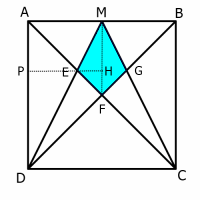 Similar triangles
Let ABCD be a unit square.
Line $AD$ is parallel to line $MF$, so $\angle EDA$ and $\angle EMF$ are equal, and $\angle EAD$ and $\angle EFM$ are equal (alternate angles).
As line $AC$ intersects line $MD$ at point $E$, the two opposite angles $\angle MEF$ and $\angle AED$ are equal.
Therefore, $\triangle AED$ and $\triangle FEM$ are similar.
The line $MF$ is half the length of $AD$.
Therefore, the line $EH$ is half the length of $PE$.
$PH$ has length $\frac{1}{2}$ units, so $PE$ has length $\frac{1}{3}$ units and $EH$ has length $\frac{1}{6}$ units.
$\triangle MEF$ has area $\frac{1}{2}(\frac{1}{2}\times\frac{1}{6}) = \frac{1}{24}$ sq units.
Therefore, the shaded area $MEFG = \frac{1}{24} \times 2 = \frac{1}{12}$ sq units.
Pythagoras
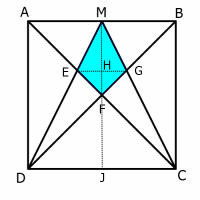
Assume that the sides of the square are each $2$ units long.
Thus, $DJ$ and $FJ$ are each $1$ unit long.
By Pythagoras, $DF$ has length $\sqrt 2$.
Area of $\triangle DFE = \frac{DF \times EF}{2}$
$= \frac{\sqrt 2 \times EF}{2} = \frac{EF}{\sqrt 2}$
$(EH)^2+(HF)^2=(EF)^2 $
$EH = HF $
$(EH)^2 = \frac{1}{2}(EF)^2$
$EH = \frac{EF}{\sqrt 2}$
Area of $\triangle MEF = \frac{1}{2}(1 \times EH) = \frac{1}{2}(\frac{EF}{\sqrt 2})$
So the shaded area $MEFG$ is equal to the area of $\triangle DFE$.
The area of $\triangle DMC = 2$ sq units.
The area of $\triangle DFC = 1$ sq unit.
Thus the combined area of $\triangle DFE$, $\triangle CFG$ and
shaded area $MEFG$ is $1$ sq unit.
Areas of $\triangle DFE$, $\triangle CFG$ and shaded area $MEFG$ are equal
so each must have an area of $\frac{1}{3}$ sq units.
The total area of the square is $4$ sq units, so the shaded area is
$\frac{1}{12}$ the area of the whole square.
Coordinates
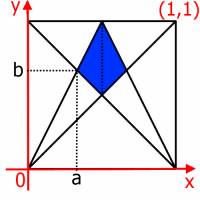 Consider a unit square drawn on a coordinate grid.
The line joining $(0,0)$ to $(1,1)$ has equation $y=x$.
The line joining $(0,0)$ to $(\frac{1}{2},1)$ has equation $y=2x$
The line joining $(0,1)$ to $(1,0)$ has equation $y=1-x$.
The point $(a,b)$ is at the intersection of the lines
$y=2x$ and $y=1-x$.
So $a = \frac{1}{3}, b=\frac{2}{3}$.
The shaded area is made up of two congruent triangles,
one of which has vertices $(\frac{1}{3},\frac{2}{3}), (\frac{1}{2},\frac{1}{2}), (\frac{1}{2},1)$.
The perpendicular height of the triangle is $\frac{1}{2}-\frac{1}{3}=\frac{1}{6}$.
Area of the triangle $= \frac{1}{2}(\frac{1}{2} \times \frac{1}{6}) = \frac{1}{24}$
Therefore the shaded area is $2 \times \frac{1}{24} = \frac{1}{12}$