Necklaces
Necklaces
Does your school have a school fair?
One of the classes in a school I often visit decided they'd have a stall where everything to be sold was as mathematical as possible!
The jewellery stall was going to carry necklaces, but mathematical ones.
Each would have four beads of one colour and four of another.
And they'd all be symmetrical like this:
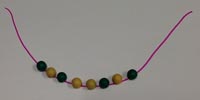
How many different necklaces do you think could be made?
How do you know you've found them all?
What if there were 9 beads, 4 of one colour and five of another?
10 beads?
11 beads?
12,13........
What can you find out?
What other things do you think they could sell on their mathematical stall?
Why do this problem?
Possible approach
Most children will find some practical apparatus useful for this activity. Beads and string are the obvious choice but can lead to frustration if threading and re-threading is time consuming. A better bet may be multilink cubes which can be stuck together (and can always be threaded later to make a display) or other similar objects in two colours.
Ask them to work in pairs to make a necklace that fits the rule. Can they make another one? And another? How many different ones can they make?
At this point you may want the children to record their necklaces, especially if you have limited resources, so that you can return to the question later. You may wish to offer outlines for the children to colour - but give these on separate slips of paper, not altogether on a worksheet as you want the children to be able to arrange and rearrange them.
Can they arrange them in some way so that they know they have them all?
The most usual arrangement is of opposite pairs (of which there are three):
YYGGGGYY and GGYYYYGG
YGYGGYGY and GYGYYGYG
YGGYYGGY and GYYGGYYG
This confirms that there is an even number but doesn't answer the much more difficult question "How do you know that you have them all?".
Key questions
Can you make another?
How are these different?
How are these the same?
How will you record what you've found out?
Is there any way of making sure you have them all?
Possible extension
Some children will be very interested in justifying their claim that they have found all the possibilities. Listen to their explanations for this is a wonderful opportunity for them to reason mathematically, and is the beginning of understanding mathematical proof.
Once they have convinced you, offer them nine beads, five of one colour and four of another. What difference does this make? What about ten, eleven, etc? Can they state any rules about the number of beads they need to make a symmetrical necklace with two colours?
Possible support
For some children just making symmetrical necklaces will be enough of a challenge. Support them in looking for the same pattern using different colour combinations, for example RGRGGRGR is the same underlying pattern as BYBYYBYB. Making generalisations like this is a very important part of thinking like a mathematician.