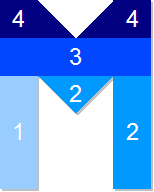
By calculating the cross-sectional area of the shapes (counting squares), the following volumes can be obtained:
| Letter | Volume $\textrm{cm}^3$ |
| I | 14 |
| L | 14 |
| O | 14 |
| V | 13 |
| E | 14 |
| M | 14 |
| A | 13.5 |
| T | 14 |
| H | 14 |
| S | 14.5 |
Therefore {I, L, O, E, M, T, H} all take the same time to fill. S takes the longest and V the shortest time.
The chart corresponds to the letter M (see diagram below for numbering):
1. 0 - 3 minutes - filling one 'leg' of M, with rate of height increase constant due to constant width
2. 3 - 7 minutes - further water will run over in to the central dip of the M, and then once this is filled into the opposite leg. These have a combined volume of $4 \textrm{ cm}^3$ and so take 4 minutes to fill
3. 7 - 11 minutes - water fills top rectangular section with constant rate of height increase
4. 11 - 14 minutes - filling up top two trapezoidal sections of M
5. 14 - 16 minutes - letter completely full - no further height gain